


 +86 15913754357
 sales@xirotech.cn

Oil-Impregnated PM Bearings: Solving Porosity Control and Production Stability with XIRO Mechanical Powder Press Introduction
 Release time:2026.01.22
Oil-impregnated powder metallurgy bearings, commonly known as self-lubricating bearings, have long faced a fundamental engineering paradox: achieving sufficient oil storage capacity while maintaining mechanical strength and dimensional accuracy. These three performance indicators—porosity structure, strength, and dimensional stability—are not independent variables. Instead, they are jointly determined by the powder densification path and stress release behavior during the compaction process.
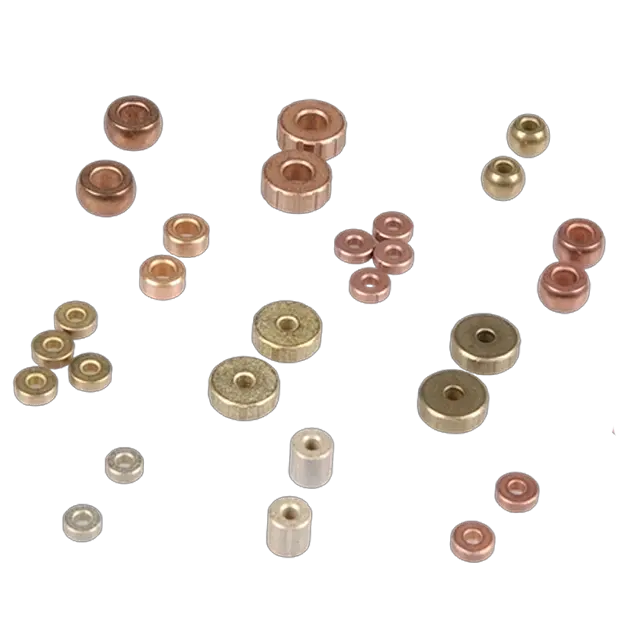
Oil-impregnated powder metallurgy bearing
(For confidentiality purposes, the product images shown are representative illustrations only and do not depict actual client-specific product)
Extensive mass production experience demonstrates that performance fluctuations in oil-impregnated bearings are rarely caused by raw material variations. Rather, they originate from insufficient process controllability and poor repeatability during powder pressing. This article takes the application of the XIRO 120-ton high-precision mechanical powder compacting press in high-load oil-impregnated bushing production as a practical case, systematically analyzing how targeted mechanical design and servo-assisted process control can fundamentally solve the core manufacturing challenges of oil-impregnated powder metallurgy bearings.
1. Three Core Challenges in Oil-Impregnated Bearing Compaction
1.1Porosity Control: The Foundation of Oil Storage Capacity and Lubrication Life
Porosity is not a single parameter, but a multidimensional system comprising total porosity, open porosity, pore connectivity, and pore size distribution. The oil impregnation rate and long-term lubrication performance of self-lubricating bearings depend primarily on the characteristics of the interconnected open-pore network.
The fundamental limitations of conventional compaction processes include:
Single pressure path: Single-stage or simple two-stage pressing shortens the particle rearrangement phase, forcing powder particles into plastic deformation before effective packing is achieved.
Uncontrolled elastic springback: Internal stress release after ejection leads to inconsistent dimensional rebound, causing secondary changes in pore structure.
Insufficient effective densification time: The lack of an equivalent dwell phase near bottom dead center prevents stable fixation of pore morphology.
1.2 Density Uniformity: Determining Bearing Strength and Service Reliability
Non-uniform internal density distribution directly leads to:
Local stress concentration and micro-crack initiation
Discontinuous oil channels and reduced lubrication performance
Insufficient dimensional stability, affecting subsequent assembly accuracy
In thin-wall bushing structures, unidirectional pressing easily produces pronounced axial density gradients, which represent a critical hidden risk for high-speed bearing applications.
1.3 Mass Production Stability: The Real Bottleneck in Scale Manufacturing
In continuous production, multiple fluctuation sources are strongly coupled:
Equipment repeatability: Valve response delay and oil temperature variation in conventional hydraulic systems cause significant pressure fluctuations.
Powder flowability variation: Batch-to-batch powder flow differences cannot be compensated in real time with manual feeding.
Excessive manual intervention: Powder filling, scraping, and part handling introduce random errors, reducing within-batch consistency.
2. Engineering Solution of the XIRO 120-Ton Mechanical Powder Press
This solution is based on a high-rigidity crank–knuckle mechanical press architecture, combined with a multi-axis servo control system. Key quality-related motions during the compaction process are closed-loop controlled, significantly enhancing forming consistency, process controllability, and automation level in mechanical powder pressing.
Application Case Background
A leading domestic precision component manufacturer supplies high-load copper-based oil-impregnated bushings for drive motors used by a major new energy vehicle OEM. The bushing supports the rotor shaft and operates under extreme conditions: rotational speeds up to 18,000 rpm, continuous temperatures above 120°C, and a lifetime maintenance-free requirement.
Key challenges included:
Severe density gradient: With a wall thickness of only 3 mm, unidirectional pressing resulted in axial density differences up to 0.35 g/cm³.
Porosity instability: Batch porosity fluctuated by ±3.5% (target: 20% ±1.5%), causing uneven oil impregnation and early dry friction during high-speed endurance tests.
Low efficiency and stability: Manual powder feeding and unloading limited yield to approximately 91%, failing to meet the daily demand of 50,000 parts.
2.1 High-Precision Compaction Control Architecture
2.1.1 Main forming force
A precision crank–knuckle mechanism supported by preloaded roller bearings provides high rigidity and stable densification near bottom dead center.
2.1.2 Servo-assisted coordinated control
During critical densification stages, servo motors coordinate multiple actuators to control:
Relative displacement and synchronization of upper and lower punches
Powder filling and pre-compaction timing
Fine adjustment of forming speed near bottom dead center
Motion profiles during ejection, stripping, and return
This control strategy effectively creates a stable equivalent dwell phase, which:
Extends particle rearrangement and plastic deformation time
Promotes internal gas release
Reduces elastic springback disturbance to pore structure
Compared with purely mechanical timing control, this servo-assisted approach significantly improves batch stability of porosity and density distribution.
2.2 Servo-Driven Forced Double-Action Pressing for Thin-Wall Structures
Forced double-action mechanism:
A precision lower punch forced pull-down system ensures proportional synchronous movement of upper and lower punches during the final compaction stage, achieving true double-action pressing and minimizing density gradients.
Floating core rod and ultra-precision guiding system:
Designed specifically for 3 mm thin-wall bushings, controlled die floating and high-precision guiding ensure axisymmetric force distribution.
Adaptive micro-powder feeding system:
A volumetric dosing shoe optimized for fine copper powders achieves ±0.5% feeding accuracy. Soft coupling and vibration assistance eliminate powder bridging in thin cavities.
2.3 Servo-Based Process Monitoring and Quality Judgment
2.3.1 Real-time signal acquisition:
Servo axis position and velocity
Main forming load feedback
Ejection resistance characteristics
2.3.2 Multi-signal fusion enables:
Within-batch consistency monitoring:
Real-time display of peak forming load, bottom dead center position, and ejection force.
Automatic defect detection and rejection:
Each part’s pressure–displacement curve is compared with a reference curve. If work deviation exceeds 2% or bottom dead center deviation exceeds 0.05 mm, the system alarms and triggers automatic rejection.
Friction compensation:
Ejection force trends indicate die wear or lubrication degradation. The HMI prompts maintenance and automatically fine-tunes motion timing to prevent thin-wall damage.
This data-driven logic replaces operator experience with objective process control.
2.4 Comprehensive Impact of Servo Control on Mass Production Stability
Servo control significantly reduces uncertainties caused by:
Manual operation-induced cycle fluctuations
Mechanical transmission backlash
Shift-to-shift and operator-to-operator variation
Achieving:
Highly reproducible forming parameters
One-click recipe changeover
Consistent product performance across batches
3. Implementation Results
3.1 Product Quality Improvements
Density uniformity: Axial and radial density variation ≤0.1 g/cm³, verified by metallographic sectioning.
Porosity control: Batch porosity standard deviation reduced from 0.9% to 0.4%, with long-term CPK ≥1.67.
Mechanical performance: Variation in radial crush strength reduced by 60%, with motor noise-related defects reduced by over 90%.
3.2 Production Stability and Efficiency Leap
Yield rate: Increased from 91% to consistently above 99.2%.
Productivity: Benefiting from high inherent cycle speed (25–30 strokes/min) and automation, daily output increased by approximately 40%.
Labor dependency: One-click changeover minimized reliance on operator experience.
3.3 Significant Economic Benefits
Capital investment: Compared with servo-electric press solutions, total line investment reduced by approximately 35%, with full ROI achieved within 14 months.
Operating cost: Lower energy consumption and simpler maintenance; die life extended by approximately 30%.
Quality cost: Customer returns and sorting costs related to compaction defects were virtually eliminated.
Conclusion
This case demonstrates that through deep engineering optimization of the forming path, XIRO mechanical powder compacting press can achieve consistency levels approaching those of servo-electric presses in demanding applications such as oil-impregnated bearings—while maintaining superior productivity and lower total cost of ownership. For high-volume powder metallurgy bearing manufacturers, servo-assisted mechanical powder presses represent a highly competitive and scalable solution.