


 +86 15913754357
 sales@xirotech.cn

From Gears to Blades: Why Mechanical Powder Press Are the Core Technology for Mass Production of Structural Parts︱XIRO
 Release time:2025.12.26
If you are involved in industries such as home appliances, power tools, automotive components, general machinery, or hard-metal cutting tools, and you are facing large-scale production demands for standard powder metallurgy structural parts
If you are involved in industries such as home appliances, power tools, automotive components, general machinery, or hard-metal cutting tools, and you are facing large-scale production demands for standard powder metallurgy structural parts—or planning a production line upgrade—one fundamental question becomes unavoidable:
How can you select the most technically and economically rational powder forming process among multiple manufacturing routes?
Among Metal Injection Molding (MIM), Cold/Hot Isostatic Pressing (CIP/HIP), hydraulic powder press machines, and mechanical powder compacting press, this article systematically explains why the mechanical powder press machine represents an irreplaceable press machine solution for mass production of structural powder metallurgy parts, from the perspectives of geometry adaptability, production scale, and total lifecycle cost.
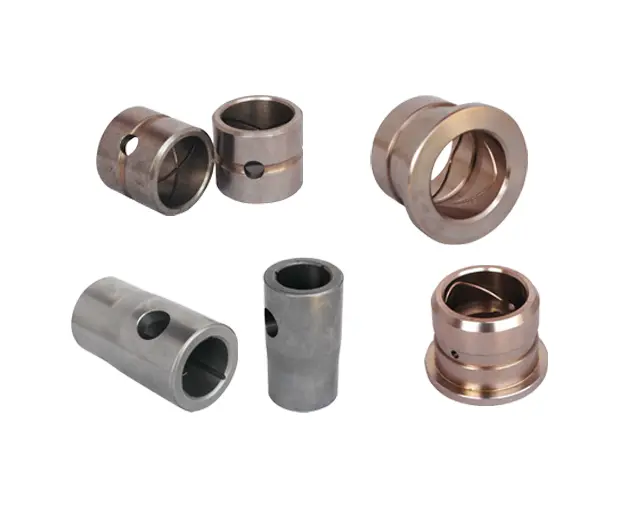
Oil-impregnated bearings
(For confidentiality purposes, the product images shown are representative illustrations only and do not depict actual client-specific product)
1. Selection of Powder Forming Technologies
Several mainstream powder compaction technologies are currently used in powder metallurgy manufacturing, each with clearly defined application boundaries.
Hydraulic (Servo Hydraulic) Powder Press Machine
Hydraulic powder press machines offer programmable pressure curves and independent multi-stage pressing control. They are widely applied in low-volume, high-mix production or in parts requiring complex density gradients.
However, under continuous high-speed production conditions, system response, repeatability, and energy efficiency are still influenced by hydraulic oil temperature fluctuations, seal wear, and long-term maintenance factors. As a result, their long-term dimensional stability and unit-part manufacturing cost are relatively limited in mass production scenarios.
Isostatic Pressing (CIP / HIP)
The core advantage of isostatic pressing lies in its excellent isotropic densification capability, achieved through uniform fluid pressure. It is particularly suitable for high-performance materials, very large components, or green bodies with extremely strict internal density uniformity requirements.
Nevertheless, CIP/HIP processes involve long cycle times, high capital investment, and high operating costs. In addition, green parts usually require extensive secondary machining, making this technology unsuitable for the mass production of standard structural parts.
Metal Injection Molding (MIM)
MIM excels in producing small, high-value precision components with complex three-dimensional geometries. However, high feedstock cost, long debinding and sintering cycles, and a narrow process window restrict its economic feasibility.
Therefore, MIM is more appropriate for small, high-value parts rather than cost-sensitive, large-volume structural components.
Mechanical Powder Compacting Press
A mechanical powder press machine uses a rigid cam or crank drive system with a fixed motion profile. This mechanical structure delivers high speed, excellent repeatability, low energy consumption, and seamless automation integration.
For medium-complexity structural parts that can be ejected axially, mechanical powder press machines demonstrate an unmatched balance of productivity, process stability, and total manufacturing cost, making them a dominant press machine solution for mass production.
2. Geometry Adaptability: Process Boundaries of Mechanical Powder compacting Press
From a geometric standpoint, mechanical powder compacting press are best suited for 2D and 2.5D components that can be ejected along the pressing direction.
Typical geometric characteristics include:
Axial symmetry or near-symmetry
Stepped profiles and blind holes
No lateral undercuts, internal threads, or transverse grooves
Typical applications include:
Powder metallurgy gears (spur gears and helical gears)
Bushings, sleeves, and oil-impregnated bearings
Flanges and structural connectors
Simple profiled blades and ring-shaped magnetic components
With proper die design and stable process control, dimensional consistency can typically be maintained within ±0.1% to ±0.3%, with excellent batch-to-batch stability.
*Process Comparison
Compared with MIM:
While MIM is suitable for highly complex micro-components, mechanical powder press machines deliver higher green density, better mechanical performance, and significantly lower unit cost for medium-complexity structural parts.
Compared with Isostatic Pressing:
Isostatic pressing addresses extreme shape complexity and isotropy, whereas mechanical powder press machines provide orders-of-magnitude advantages in dimensional precision, surface finish, and production throughput.
Practical Guideline:
If all critical features of your part can be fully defined by front, top, and sectional views—without requiring side-core mechanisms—the component is highly suitable for a mechanical powder compacting press.
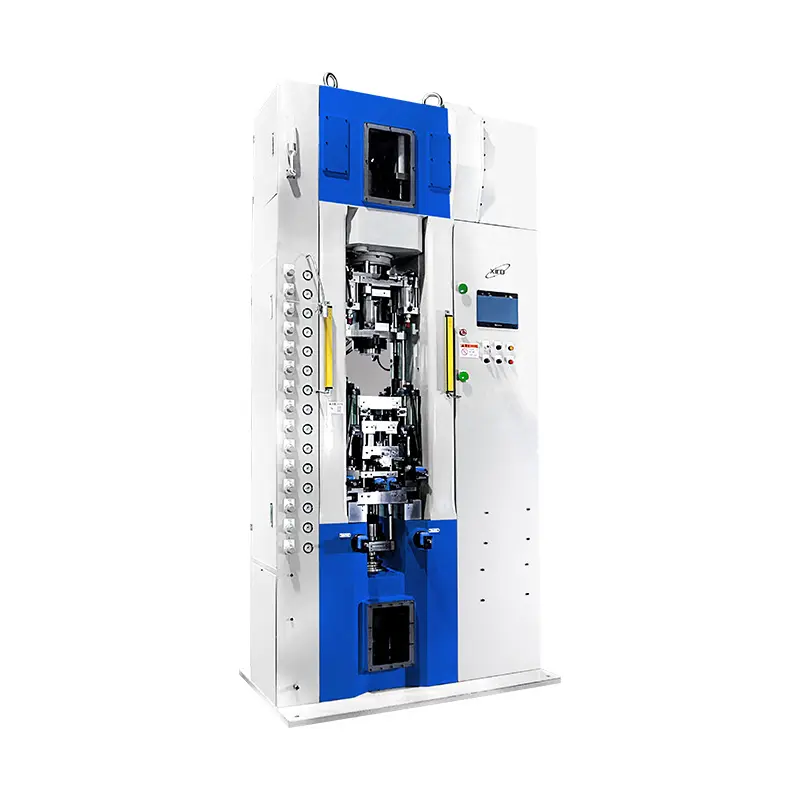
XIRO Mechanical Powder Compacting Press (Customizable)
3. Mass Production Economics: Speed, Precision, and Automation
The core value of XIRO mechanical powder press lies in its inherent compatibility with large-scale manufacturing.
High production rate: Stable operating speeds of 20–100 strokes per minute
Excellent repeatability: Mechanical bottom-dead-center positioning ensures consistent pressing depth and minimal dimensional variation
Automation readiness: Easy integration with automatic powder feeding, weight control, in-line inspection, and robotic part handling
In high-volume production of structural powder metallurgy parts, these advantages translate directly into a significantly lower cost per component.
4. Materials and Performance: Balancing Manufacturability and Scale
With appropriate machine configuration and tooling design, mechanical powder compacting press machines can process:
Iron-based and copper-based powders
Selected stainless steel grades
Magnetic materials
Hard metal and ceramic materials (under specific high-tonnage and tooling conditions)
Through multi-level compaction and sizing operations, manufacturers can achieve:
High and uniform green density
Excellent green strength for handling and sintering
Net-shape or near-net-shape capability, minimizing material waste and secondary machining
This represents a clear advantage over MIM (which requires debinding) and isostatic pressing (which often requires extensive machining).
5. Typical Application Case: Automotive Powder Metallurgy Gears
1) Production Challenges
Annual demand at million-piece scale
Strict requirements on gear profile and bore concentricity
Dimensional consistency directly affecting NVH (Noise, Vibration, Harshness) performance
2) Solution
XIRO mechanical powder press machine equipped with a customized multi-upper-and-lower punch tooling system was adopted. The system precisely controls powder filling weight and bottom-dead-center position, while integrating automatic powder feeding and real-time process monitoring.
3) Results
Significantly increased production rate per part
Highly stable green part consistency and reduced post-sintering dimensional variation
Unit manufacturing cost substantially lower than hydraulic press and MIM solutions
Conclusion: How to Select the Optimal Press Machine for Your Product
Large-volume production of structural parts?
→ Mechanical powder press machine
Small batches or special density profiles required?
→ Hydraulic powder press machine
Highly complex 3D geometry?
→ MIM or additive manufacturing
Very large parts or extreme isotropic requirements?
→ Isostatic pressing
XIRO mechanical powder press is the industrial foundation for achieving large-scale, low-cost, and high-quality production of powder metallurgy structural parts. When your goal is to deliver consistent quality at the most competitive cost, it remains the most reliable press machine solution.