


 +86 15913754357
 sales@xirotech.cn

Powder Metallurgy Gear Manufacturing: Key Challenges, Press Machine Selection, and Automotive Applications丨XIRO
 Release time:2026.01.09
In precision machinery and automotive manufacturing, gears are core functional components responsible for power transmission. Their manufacturing quality has a direct impact on system performance, durability, and reliability. Thanks to its near-net-shape capability, high material utilization, and suitability for mass production, powder metallurgy (PM) has become an important manufacturing route for automotive gears.
However, as modern vehicles evolve toward higher speeds, higher torque density, lower noise levels, and electrification, traditional powder metallurgy gears increasingly face limitations in density uniformity, dimensional stability, and functional integration. Selecting the appropriate powder metallurgy process route and press machine configuration has therefore become a critical engineering decision.
.webp "Gear(3).webp")
Powder Metallurgy Gear
(For confidentiality purposes, the product images shown are representative illustrations only and do not depict actual client-specific product)
1. Core Process Challenges in Powder Metallurgy Gear Manufacturing
1.1 Non-Uniform Density Distribution and Limited Mechanical Performance
Powder metallurgy gears typically feature complex geometries with significant variations in section thickness, such as gear teeth, hubs, and webs. Under conventional single-action or simple double-action pressing, powder flow paths and compaction resistance differ substantially within the die cavity, resulting in pronounced density gradients.
Non-uniform density directly leads to several performance limitations:
Reduced fatigue strength: Pores act as stress concentrators, becoming crack initiation sites under cyclic gear meshing loads, limiting both bending and contact fatigue life.
Lower impact toughness and ductility: Porosity disrupts the continuity of the metallic matrix, reducing the material’s ability to absorb energy through plastic deformation.
Limited dynamic load capacity: Under high load and high-speed conditions, low-density regions often become early failure points.
Case Study
A camshaft timing gear used in an automotive engine valve train features a central boss and relatively thin gear teeth on both sides. During conventional pressing, powder preferentially flows toward the tooth region with lower resistance, resulting in high tooth density but insufficient density in the central boss. After sintering, radial cracking may occur in the boss area during bolt tightening.
Solution: Servo-Controlled Mechanical Powder Press Technology
XIRO mechanical powder compacting press retain the high rigidity and stability of traditional mechanical main drives (crankshaft or eccentric shaft) while introducing servo control technology for precise adjustment of punch stroke and phase relationships.
In this architecture, the main compaction force is still generated by the mechanical drive system, ensuring excellent rigidity, repeatability, and suitability for high-tonnage, high-speed production. The servo system does not directly provide pressing force; instead, it independently controls the relative displacement of the upper punch, segmented lower punches, and core rod to achieve dynamic compensation.
Upper Punch: Applies the primary compaction force from top to bottom, maintaining its conventional function.
Lower Punch: Designed as a segmented structure with independently adjustable stroke sections, such as an outer segment corresponding to the gear teeth and boss area, and a central segment corresponding to the hub or web region.
Core Rod: Forms the inner bore and participates in density adjustment around the bore area through servo-controlled positioning.
This hybrid concept of “mechanical force output combined with servo-controlled positioning” enables precise allocation of compaction ratios across different regions of the part. As a result, density distribution uniformity is significantly improved under single cold-press conditions, approaching the density-gradient control effects typically associated with warm compaction or double pressing.
2. Long-Term Stability of Dimensional Accuracy and Geometric Tolerances
Gears are high-precision transmission components, with tooth profile errors, lead errors, and total radial runout (FRT) controlled at the micron level. Dimensional variation in powder metallurgy gears mainly originates from:
Non-uniform powder filling and green density variation, especially in tooth regions.
Elastic spring-back after unloading, caused by residual internal stresses.
Unavoidable sintering shrinkage and batch-to-batch variation, influenced by powder composition, particle size distribution, sintering temperature, time, atmosphere, and prior density distribution.
For gears requiring DIN 7 accuracy or higher, even minor fluctuations present significant challenges.
Case Study:
Reduction pinions used in electric power steering (EPS) systems have strict requirements for noise and backlash. When produced on press machines with insufficient rigidity, accumulated frame deformation and guide wear gradually increase gear runout, resulting in elevated NVH levels.
Solutions
2.1 Ultra-High Rigidity Machine Frame Design
Under an equivalent pressing load of 500 tons, conventional mechanical presses typically exhibit system stiffness in the range of 1.5–2.5 kN/μm. XIRO mechanical powder press employ a closed-frame structure and optimized force transmission paths to significantly reduce elastic deformation. Since press deformation directly translates into relative die displacement, high rigidity provides a fundamental physical basis for dimensional repeatability.
2.2 Zero-Clearance Precision Guiding System
Preloaded roller or needle linear guide systems eliminate the oscillation and play associated with traditional sliding guide bushings, effectively suppressing FRT drift.
2.3 Long-Term Stable Guide Maintenance Strategy
Maintenance-free lubrication systems or special surface coatings ensure optimal guide lubrication during long-term high-speed operation (e.g., ≥30 strokes per minute), preventing wear-induced clearance growth.
3. Lateral Feature Forming and Post-Processing Cost Reduction
Many automotive gears or hubs require lateral features such as locating pin holes, keyways, or oil passages. Conventional vertical ejection rules prevent these features from being formed directly during pressing, making secondary machining unavoidable and introducing additional cost and dimensional risk.
Case Study
A shift hub used in an automatic transmission requires two φ5 mm locating pin holes positioned 180° apart on the flange. Traditional drilling after sintering suffers from accumulated positional error and burr formation, with a defect rate of approximately 2.5%.
Solution: Integrated Cam-Driven Lateral Forming System
XIRO mechanical powder compacting press integrate symmetrically arranged wedge-driven lateral forming mechanisms within the die set. The key lies in precise forming sequence control:
Primary compaction is completed while the part remains fully constrained within the die cavity.
During the return stroke of the upper punch, vertical motion is converted into horizontal motion through inclined cam surfaces.
Lateral punches penetrate the constrained green compact, forming dense, burr-free lateral holes.
The lateral punches retract, allowing safe vertical ejection.
This approach stabilizes pin-hole positional accuracy within ±0.02 mm, produces dense hole walls without secondary defects, and reduces the defect rate to below 0.1%.
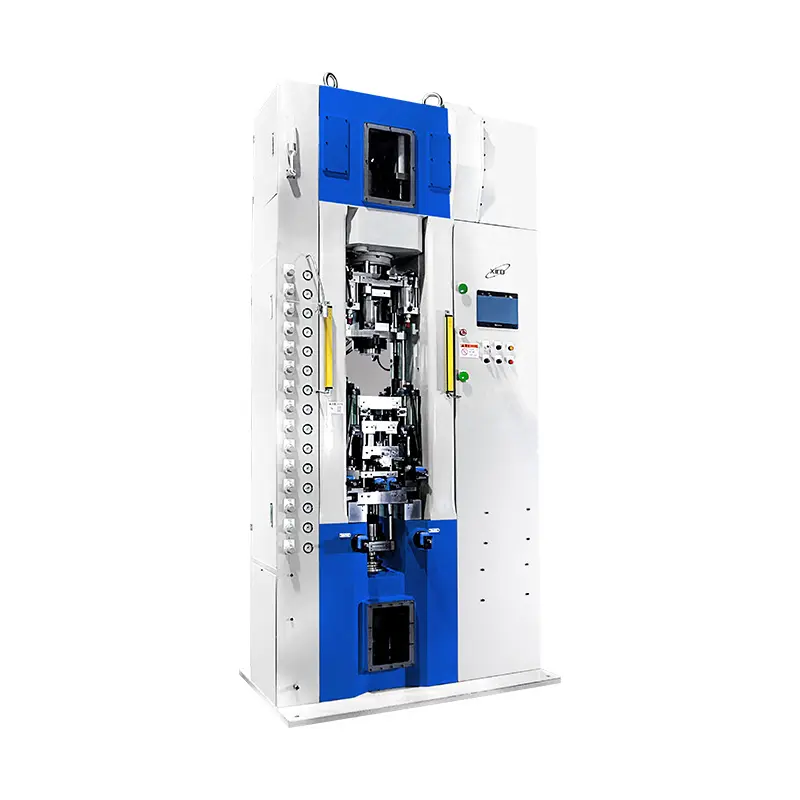
XIRO Mechanical Powder Compacting Press (Customizable)
Conclusion
In automotive powder metallurgy gear manufacturing, true competitiveness does not rely on a single material or isolated process parameter, but on the system-level coordination of press machine, tooling, and process design. With XIRO high-rigidity mechanical powder compacting press as the foundation, combined with servo-controlled multi-punch density regulation, stable dimensional control, and integrated functional forming, powder metallurgy gears continue to expand their application boundaries toward higher load capacity, higher precision, and higher reliability in modern automotive systems.