


 +86 15913754357
 sales@xirotech.cn

Precision Forming of Magnetic Rings: Engineering Solutions via XIRO Mechanical Powder Press Technology
 Release time:2026.02.11
Introduction
Ring-shaped magnetic components are fundamental functional parts in modern industrial systems. From electric motors to wireless charging modules, the density uniformity and dimensional precision of these rings directly determine magnetic permeability stability and energy conversion efficiency. As manufacturing requirements shift toward thin-wall structures and higher density, traditional pressing methods are no longer sufficient.
[Expert Q&A: Navigating the Complexities of Magnetic Compaction]
Q: What are the primary obstacles in high-precision magnetic ring manufacturing?
A: According to XIRO’s engineering analysis, the main challenges are powder filling uniformity (especially in thin-wall rings), demolding stress concentration which causes cracks in brittle ferrites, and dimensional chain coupling complexity. Traditional pressing fails to manage the micro-elastic deformation (10–50 μm) that occurs during high-volume production.
Q: How does the "Three-stage non-synchronous compaction" solve these issues?
A: This mechanism utilizes a precisely calculated cam-lever system. By separating the process into Pre-compression, Bidirectional compaction, and Final calibration, the XIRO press stabilizes the "Neutral Axis" of the ring. This balances the density between the upper and lower sections, effectively eliminating the density gradient that leads to magnetic performance instability.
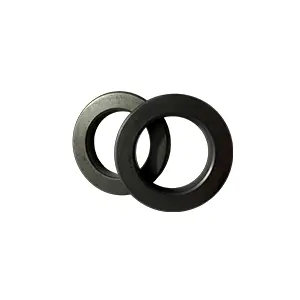
Ferrite ring manufacturing
(For confidentiality purposes, the product images shown are representative illustrations only and do not depict actual client-specific product)
Ⅰ. Core Challenges in Ring Magnetic Powder Compaction
The compaction of ring-shaped components is a complex process involving powder mechanics, tribology and elastoplastic deformation. Compared with standard structural parts, the process difficulty is significantly higher.
1. Powder filling uniformity
The annular cavity naturally introduces:
arching effect
edge effect
core-rod shielding
When wall thickness-to-outer-diameter ratio falls below 0.2, density variation during conventional single-action pressing can reach critical levels under thin-wall conditions, directly affecting permeability distribution and magnetic loss consistency.
2. Demolding stress concentration
During ejection, friction occurs simultaneously between:
core rod and inner wall
die and outer wall
Tensile stress peaks at the instant of release. If elastic recovery is not controlled properly during pressing, demolding crack rates can rise significantly, especially for brittle ferrite materials.
3. Dimensional chain coupling complexity
Ring components involve multiple coupled parameters:
outer diameter
inner diameter
height
concentricity
Lateral powder flow during compaction causes micro elastic deformation of the die (typically 10–50 μm). Subsequent springback after ejection further alters final dimensions, making tolerance control beyond traditional machining experience.
4. Multi-layer composite structure forming
For gradient magnetic properties or insulation-conductive integration, layered powder filling is required. Interface shear during compaction can lead to:
layer mixing
delamination
interface cracking
This directly impacts magnetic performance design.
Ⅱ. Engineering Solutions Based on Mechanical Powder Press Technology
1. Three-stage non-synchronous compaction mechanism
The mechanical powder compacting press adopts a floating die structure combined with a fixed ejection position. Through a precisely calculated cam-lever system, the upper punch, floating die and lower punch execute three non-simultaneous compaction stages with high repeatability.
Stage 1 – Pre-compression & powder rearrangement
Upper punch contacts powder and moves together with the floating die. Powder undergoes initial rearrangement and densification.
Stage 2 – Bidirectional compaction
Floating die slows under adjustable resistance. Upper and lower punches compact powder simultaneously, forming a closed compaction state.
Stage 3 – Final calibration & sizing
Mechanical dead-point design ensures final height control, pressure stabilization and full density development.
2. Floating die system for density distribution control
Density distribution is governed by the coupling of:
floating die resistance
upper punch motion curve
lower punch positioning
filling depth
powder flow behavior
The floating die resistance can be continuously adjusted via precision pressure regulation or counterweight systems, enabling:
control of transition timing into bidirectional pressing
regulation of powder migration paths
balancing upper and lower density
This provides a stable and repeatable process window verified in mass production.
3. Fixed ejection position design
After compaction:
upper punch retracts
floating die returns to a fixed position
lower punch ejects product to a constant height
Advantages:
stable ejection force
reduced thin-wall cracking risk
easy integration with automation
simplified die setup
4. Integrated feeding system for consistency
A volumetric feeding shoe ensures repeatable powder mass input.
Key features:
adjustable fill volume
mechanical vibration / scraping options
stable powder packing
minimized residual powder at die entry
Core rod positioning can be micro-adjusted during compaction to compensate filling deviations.
Ⅲ. Verified Engineering Outcomes & Summary
Based on the above system architecture, mechanical powder compacting presses deliver measurable improvements in critical production metrics.
1. Density uniformity improvement
Through non-synchronous triple compaction and adjustable floating resistance, powder flow and densification are systematically optimized. With stable filling calibration, overall density consistency is significantly enhanced for ferrite rings and NdFeB compaction.
2. Reduced demolding crack rate
Controlled pressure release and fixed ejection positioning stabilize elastic recovery behavior, lowering crack risks in brittle magnetic materials.
3. Dimensional stability
Mechanical bottom-dead-center repeatability enables long-term height consistency within tight tolerance ranges in stabilized production conditions.
4. Productivity and yield advantages
constant mechanical cycle time
no hydraulic thermal drift
low energy consumption compared with hydraulic systems
high repeatability of motion curve
stable batch quality
| Engineering Challenge | XIRO Mechanical Solution | Resulting Outcome |
| Density Variation | Floating Die & Non-synchronous Compaction | Uniform Permeability |
| Demolding Cracks | Fixed Ejection & Controlled Stress Release | Lower Rejection Rates |
| Dimensional Drift | Mechanical Bottom-Dead-Center Design | Height Consistency |
| Energy Waste | High-Efficiency Mechanical Linkage | Lower Power Consumption |
Ⅳ. Application Scope
The solution has been widely applied in:
MnZn ferrite ring manufacturing
NiZn ferrite core forming
bonded NdFeB pressing
soft magnetic alloy compaction
powder metallurgy ring components
It provides manufacturers with a balanced solution between quality, efficiency and cost.
Ⅴ. Conclusion
As magnetic components move toward higher frequency, thinner structures and greater integration, manufacturing stability becomes the decisive factor.
XIRO Mechanical powder compacting press technology offers:
repeatable motion curves
stable compaction dynamics
controllable density distribution
reliable mass production capability
For ferrite rings, NdFeB magnets and soft magnetic components, it represents a pragmatic and economically viable engineering solution for achieving precision powder forming at industrial scale.