


 +86 15913754357
 sales@xirotech.cn

Mechanical vs Hydraulic Powder Press: How to Choose? (2026 Guide)
 Release time:2026.03.13
Quick Conclusion
If you need a quick selection rule:
| Production Requirement | Recommended Press |
| High-volume powder metallurgy parts | Mechanical Powder Press |
| Complex shapes or large parts | Hydraulic Powder Press |
| Ultra-high production efficiency | Mechanical Powder Press |
| Flexible forming processes | Hydraulic Powder Press |
In general:
Mechanical powder presses are ideal for high-volume production of small to medium precision powder metallurgy parts, especially where dimensional consistency and productivity are critical.
Hydraulic powder presses are better suited for large components, complex geometries, high H/D ratios, or processes requiring pressure dwell.
This guide compares the working principles, precision, cost, and real industrial applications of both technologies to help engineers select the right powder compaction equipment.
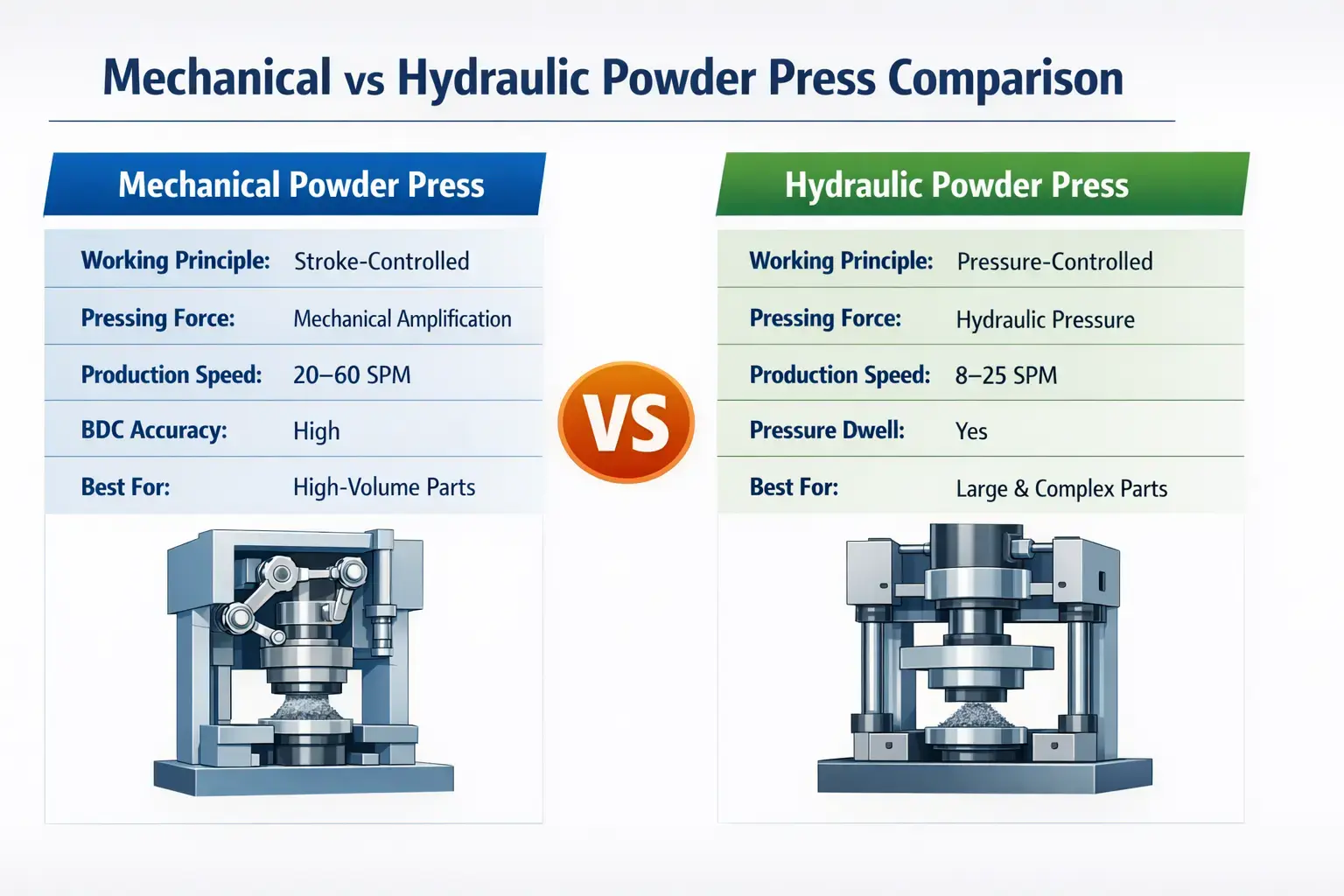
1 Working Principle: Stroke Control vs Pressure Control
Mechanical Powder Press(Stroke-Controlled System)
A mechanical powder compaction machine converts motor rotation into reciprocating motion through mechanisms such as:
crankshaft
connecting rods
toggle systems
cam mechanisms
The bottom dead center (BDC) position of the slide is mechanically fixed.
As the slide approaches the BDC, the mechanical transmission ratio of the crank mechanism increases rapidly, amplifying the pressing force and compacting the powder.
Key Characteristics
Pressing force generated through mechanical force amplification
Part height determined by BDC position
Flywheel energy storage enables high-speed production
Typical production speed: 20–60 strokes per minute (SPM) depending on machine tonnage
Because of this stroke-controlled mechanism, mechanical presses provide excellent repeatability in compact height, making them ideal for mass production of precision powder metallurgy parts.
Hydraulic Powder Press(Pressure-Controlled System)
Hydraulic powder presses use hydraulic cylinders driven by pressurized oil to generate pressing force.
Unlike mechanical presses, hydraulic systems allow flexible control of both pressure and speed throughout the stroke. The press can also hold pressure at the bottom position, which is useful for certain materials.
Key Characteristics
Pressing force generated by hydraulic pressure
Full stroke pressure control
Ability to perform pressure dwell (holding time)
Flexible for complex forming processes
Hydraulic presses typically operate at lower production speeds, but they provide greater process flexibility.
2 Cost Comparison: Initial Investment vs Operating Cost
Initial Investment
Mechanical Powder Press
Higher manufacturing precision requirements
Complex transmission components (crankshaft, bearings, linkages)
Typically 20–50% more expensive than hydraulic presses of the same tonnage.
Hydraulic Powder Press
Simpler mechanical structure
Standardized hydraulic components
Generally lower initial purchase cost, especially for large tonnage machines.
Operating Cost
Energy Consumption
Mechanical presses use a flywheel energy storage system, allowing energy to accumulate and release during pressing cycles.
As a result, energy consumption during high-volume production is significantly lower than hydraulic presses.
Hydraulic presses require continuous operation of hydraulic pumps, which leads to higher electricity consumption.
Maintenance Cost
Mechanical press maintenance mainly involves:
bearings
guideways
lubrication systems
Maintenance intervals are relatively long.
Hydraulic presses require regular inspection and replacement of:
seals
filters
hydraulic oil
Hydraulic oil leakage can also increase maintenance frequency.
Overall Cost Comparison
For high-volume production (millions of parts annually), the higher efficiency and lower energy consumption of mechanical presses significantly reduce unit production cost.
For low-volume or multi-variety production, hydraulic presses may be more economical due to their flexibility and lower initial investment.
3 Precision Comparison: BDC Repeatability vs Pressure Control
Mechanical Press Advantage: BDC Repeatability
The key precision parameter of a mechanical powder press is BDC repeatability.
High-precision powder presses can achieve:
BDC repeatability ≤ ±0.02 mm
This ensures extremely stable green compact height, which is essential for large-scale production.
Typical applications include:
powder metallurgy gears
motor structural parts
automotive PM components
Hydraulic Press Advantage: Pressure Control
Hydraulic presses excel in pressing force control.
Using servo valves or proportional valves, pressure repeatability can reach:
±1% or better
This allows:
multi-stage compaction
gradual pressure increase
improved density distribution in complex parts
Such capabilities help reduce density gradients and internal cracking.
Precision Summary
| Aspect | Better Choice |
| Height consistency | Mechanical press |
| Complex density control | Hydraulic press |
| Process flexibility | Hydraulic press |
4 Application Comparison: When to Choose Each Type
Mechanical Powder Press Is Ideal For
Small to medium parts
Projection area typically<100 cm²
Production rate >10 parts/min
High dimensional consistency requirements
Conventional powder metallurgy materials such as:
- iron powder
- copper powder
Recommended H/D ratio ≤1.5, though ratios up to 2.5 can be achieved with double-action pressing or floating die systems.
Hydraulic Powder Press Is Ideal For
Large parts requiring >5000 kN pressing force
Complex shapes with multiple steps
Processes requiring pressure dwell
Materials prone to cracking such as:
- ceramics
- carbide powders
Hydraulic presses are also more suitable for:
high H/D ratio parts (>2.5)
small batch, multi-product production
5 How to Select the Right Powder Press
A practical selection process usually includes the following steps.
Step 1: Analyze the Part
Key factors include:
projection area
material type
production volume
dimensional tolerance
H/D ratio
Pressing force can be roughly estimated using:
Pressing Force = Projection Area × Compaction Pressure
Typical compaction pressure for iron powder metallurgy parts: 400–800 MPa
Step 2: Evaluate Production Volume
High-volume production → mechanical press preferred
Multi-variety or low-volume production → hydraulic press preferred
Step 3: Check Equipment Capability
Verify whether the selected press meets:
tonnage requirement
stroke length
die configuration
automation compatibility
If possible, trial compaction tests are recommended.
Not sure how to choose? Feel free to contact our engineering team. We offer free technical consultation and trial mold services to help you find the most suitable press solution.
Engineering FAQ
1. Can mechanical presses produce ceramic parts? ▼
2. Can hydraulic presses achieve the same productivity as mechanical presses? ▼
3. Are parts with H/D >2 only suitable for hydraulic presses? ▼
4. What are the maintenance intervals for each type? ▼