


 +86 15913754357
 sales@xirotech.cn

Mechanical Powder Press Selection Guide (2026 Edition)
 Release time:2026.03.06
1. What Is a Mechanical Powder Press?
Definition
A mechanical powder compacting press is a powder compaction machine that converts rotary motion into reciprocating linear motion through mechanical transmission systems (such as crankshaft, toggle, or cam mechanisms). Compaction force is generated by mechanical geometry amplification, and part height is controlled by the bottom dead center (BDC) position of the slide.
Key Characteristics
Stroke-controlled compaction
Flywheel energy storage
High-speed cyclic production
Stable dimensional repeatability
This distinguishes it fundamentally from hydraulic presses, which rely on fluid pressure and pressure-based control.
2. Mechanical vs Hydraulic Press – Quick Comparison
| Criteria | Mechanical Press | Hydraulic Press |
| Force source | Mechanical linkage | Hydraulic oil pressure |
| Control principle | Stroke control | Pressure control |
| Production speed | High (up to 12–55 RPM for small tonnage) | Moderate to low |
| Dwell capability | Limited | Adjustable & long dwell |
| Energy efficiency | Flywheel energy storage | Continuous hydraulic system |
Industry Rule of Thumb
High-volume small or medium parts → Mechanical press
Very high tonnage or long dwell requirement → Hydraulic press
3. Types of Mechanical Powder Presses
Mechanical powder compacting presses are typically divided into four structural types:
3.1 Cam-Driven Press
Motion defined by cam profile
Simple structure
Limited force capacity
Suitable for wet pressing or simple geometries
3.1.1 Mechanical Advantage of Crank Mechanism
The crank-link mechanism in mechanical powder presses not only converts rotational motion into linear motion but also provides mechanical advantage that varies throughout the stroke.
Definition
Mechanical advantage (MA) is the ratio of output force at the slider to the input torque at the crank.
Force Curve
As the crank rotates, the MA is highest near the bottom dead center (BDC), enabling maximum pressing force with minimal motor input.
Practical Impact
This ensures uniform compaction, reduces energy consumption, and allows precise control of powder density, especially near the BDC.
3.2 Crank-Driven (Eccentric) Press – Market Mainstream
Operating Principle
Crankshaft rotation drives a connecting rod, producing reciprocating slide motion.
Slide velocity follows an approximately sinusoidal pattern:
Maximum speed at mid-stroke
Zero velocity at TDC and BDC
Near BDC, mechanical advantage increases rapidly, producing peak compaction force.
Why It Dominates
Mature mechanical structure
Stable BDC repeatability
High productivity
Lower maintenance complexity
Typical small-tonnage models operate at 12–55 RPM depending on part complexity.
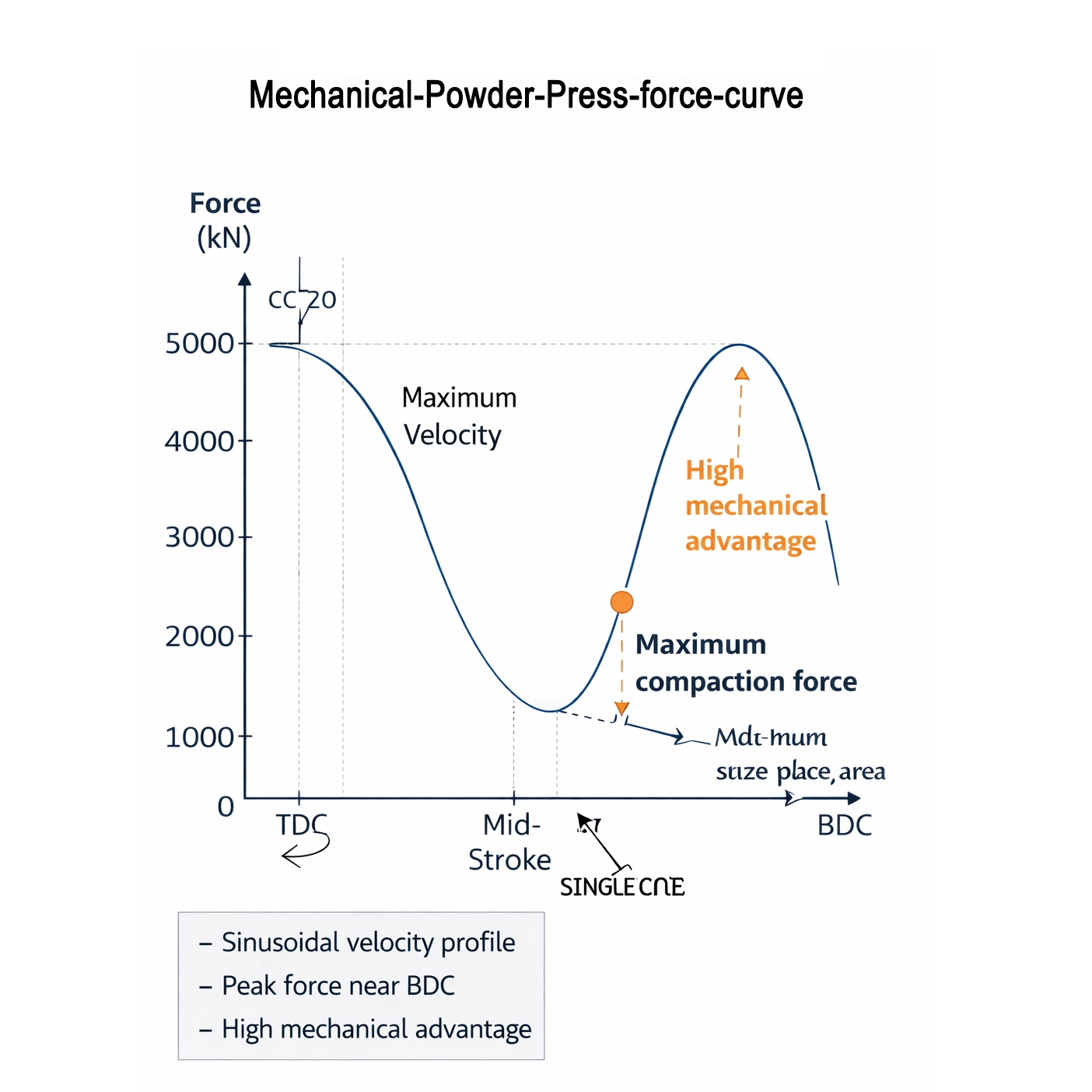
Mechanical powder press force curve curve
(Source: XIRO )
3.3 Toggle Press
Force amplification near straight toggle alignment
Very high force near BDC
Very low compaction-zone velocity
More complex and higher cost
Suitable for short-stroke, high-force precision applications.
3.4 Rotary Table Press
Multi-station continuous compaction
Extremely high output (30,000–60,000 pcs/hour for small parts)
Lower force capacity (typically ≤400 kN)
Best suited for simple geometry mass production.
4. Three Critical Engineering Selection Parameters
4.1 BDC Repeatability (Bottom Dead Center Accuracy)
Definition
BDC repeatability is the maximum positional deviation of the slide at bottom dead center over repeated production cycles.
Why It Matters
In stroke-controlled compaction, final part height is determined directly by BDC position.
For precision components requiring ±0.02 mm height tolerance: Recommended BDC repeatability: ±0.01–0.02 mm
It is important to distinguish between:
Static assembly precision
Dynamic repeatability during continuous operation
4.2 Frame Rigidity & Eccentric Load Capacity
During multi-level compaction or asymmetric part geometry, off-center loads occur.
Engineering Recommendation
Eccentric load should not exceed 10–15% of rated press capacity.
Insufficient rigidity may cause:
Slide tilting
Tool wear acceleration
Density variation
Cracking risk
4.3 Height-to-Diameter Ratio (H/D Ratio)
H/D ratio = Part height / Part diameter
This parameter determines suitability for slender components.
Recommended Industry Ranges
| Material | Recommended H/D |
| Iron-based powder metallurgy | ≤1.5–2.0 |
| Cemented carbide | ≤1.2–1.5 |
| Technical ceramics | ≤1.2–1.5 |
When H/D > 2:
Wall friction increases significantly
Lateral pressure rises
Density gradient becomes critical
Mitigation options:
Double-action pressing
Optimized die design
Hydraulic press consideration
5. Engineering Calculation Methods
5.1 Compaction Force Calculation Formula
F (kN) = A (cm²) × P (MPa) × 0.1
Where:
A = projected area
P = unit compaction pressure
Typical Pressure Reference Ranges
Iron-based PM: 400–700 MPa
Cemented carbide: 200–350 MPa
Ceramics: 80–150 MPa
Selection Recommendation
Choose rated press capacity at 1.2–1.4 × calculated force.
5.2 Fill Height Verification
H_fill = h × K
Where:
h = final part height
K = compression ratio
Typical K values:
Iron-based: 2.0–2.5
Carbide: 2.5–3.5
Ceramics: 2.5–4.0
Requirement:
Maximum fill depth ≥ calculated H_fill
5.3 Ejection Stroke & Force
Ejection stroke ≥ part height + 5–10 mm
Ejection force typically 15–35% of main compaction force
Depends on:
Tooling design
Lubrication
Material friction behavior
5.4 Speed Selection
Simple geometry → higher RPM
Multi-level or crack-sensitive materials → lower RPM
Engineers should ensure flywheel energy capacity matches required compaction work per cycle.
6. Step-by-Step Mechanical Powder Press Selection Logic
Define material and target density
Calculate projected area
Determine compaction pressure
Apply force formula
Add safety factor (1.2–1.4×)
Verify fill depth
Check H/D ratio
Evaluate production speed requirement
Assess BDC repeatability and frame rigidity
7. Industry Summary
Mechanical powder compacting presses are best suited for:
Small to medium-sized structural components
High-volume production
Applications requiring tight height tolerances
Stroke-controlled density consistency
Hydraulic presses are preferred for:
Very high tonnage requirements
Long dwell compaction
Very tall or complex compaction profiles
8. About XIRO Mechanical Powder Press
XIRO develops mechanical powder compaction systems for powder metallurgy, cemented carbide, and magnetic materials applications.
Core design features include:
Floating die compaction systems
Multi-stage pressing technology
High-rigidity frame structures
PLC-based monitoring and control
Configurable tooling structures
Technical consultation and sample validation services are available upon request. Contact us!
Author: Wang Gong
Senior Powder Metallurgy Engineer
15 years experience in powder compacting press technology
Member of Chinese Mechanical Engineering Society
Engineering FAQ
1. 1. How do you calculate the required tonnage for a mechanical powder press? ▼
2. 2. What is the acceptable H/D ratio in powder compaction? ▼
3. 3. When should a hydraulic powder press be selected instead of a mechanical press? ▼
4. 4. What are the most common defects in mechanical powder compaction? ▼
5. 5. Can mechanical powder presses achieve high-density structural parts? ▼