


 +86 15913754357
 sales@xirotech.cn

Mechanical Powder Press for Profiled Blades: Solving 3 Critical Powder Metallurgy Challenges | XIRO
 Release time:2026.02.06
Introduction
In the powder metallurgy manufacturing of profiled blades and industrial cutting tools, engineers constantly face stringent requirements for geometric accuracy, density uniformity, and structural integrity.
Problems such as edge chipping, contour variation, and green compact damage do not only affect tool life and cutting performance. They also directly influence production efficiency, yield rate, and overall manufacturing cost.
Against this background, the mechanical powder compacting press has become an important forming solution in modern powder metallurgy production lines.
With its high structural rigidity, stable kinematic characteristics, and highly repeatable pressing cycles, this type of press machine provides a reliable engineering approach for high-precision blade forming.
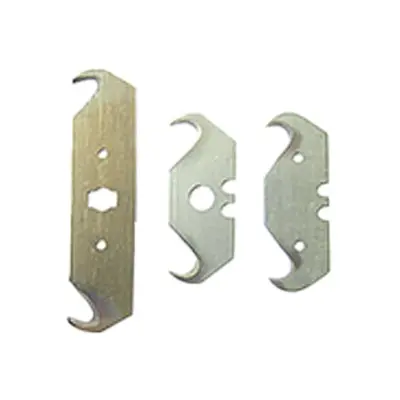
Profiled Blades
(For confidentiality purposes, the product images shown are representative illustrations only and do not depict actual client-specific product)
Challenge 1: Insufficient Edge Strength — Achieving Density Homogenization
Cutting edges, sharp corners, and thin-wall areas of profiled blades are particularly vulnerable to low density during powder compaction.
This problem is often caused by:
uneven powder filling
die-wall friction
local stress variations in complex geometries
After sintering, these areas may become the origin of edge chipping, premature wear, or fracture.
Mechanical Powder Press Solution
The core advantage of a mechanical powder compacting press lies in its rigid structure and precise crank or toggle drive system. This differs fundamentally from hydraulic presses that rely on fluid pressure transmission.
1. High Repeatability of Bottom Dead Center (BDC)
The slide’s bottom dead center is mechanically defined by the crank angle or toggle geometry.
As a result, each pressing cycle maintains extremely consistent positioning. This greatly reduces density variation in critical edge regions caused by stroke fluctuation.
2. Stable and Predictable Ejection Process
During profiled blade forming, the ejection stage plays an important role in maintaining edge integrity.
Mechanical presses provide fast response and synchronized motion through rigid drive transmission. This ensures consistent ejection force and reduces friction-induced damage on fragile blade edges.
3. Multi-Punch Configuration for Local Density Control
For complex blade geometries, the press can be equipped with:
multiple upper punches
multiple lower punches
floating core structures
These configurations allow localized compaction adjustments in critical areas such as edges and thin walls.
When combined with optimized tooling design—such as taper structures, floating support systems, and lubrication management—the mechanical powder press can significantly improve density uniformity at blade edges.
After sintering, the component achieves a more uniform microstructure and stable hardness distribution. In practical applications, blade service life can increase by over 30%.
Challenge 2: Poor Contour Consistency — Maintaining Geometric Repeatability
Profiled blades typically contain complex geometries such as curved profiles, multi-angle surfaces, and precision tooth structures.
Even small contour deviations during forming may later cause:
assembly interference
unstable cutting trajectories
abnormal wear during operation
Precision Control with Mechanical Powder Press Technology
1. High Structural Rigidity Under Pressing Loads
Mechanical powder presses adopt high-rigidity frames and precision guiding systems.
Even under high-tonnage compaction conditions, structural deformation remains minimal. This ensures accurate relative positioning between punches and dies throughout the forming process.
2. Servo Motion Control in Modern Mechanical Presses
Modern servo mechanical powder compacting presses combine deterministic mechanical transmission with closed-loop servo control.
This enables:
precise speed and position control during filling, pressing, holding, and ejection
optimization of powder particle rearrangement based on material characteristics
highly repeatable motion trajectories for consistent contour replication
3. Stable Production Rhythm
Mechanical presses operate with fixed cycle times and high production rhythm, making them particularly suitable for automated production lines.
Stable operation helps maintain consistent die temperature and lubrication conditions. This reduces dimensional drift caused by thermal expansion or friction variation.
Under mass production conditions, key contour dimensions of profiled blades can reach CPK values above 1.67, significantly reducing post-sinter machining requirements.
Challenge 3: Green Compact Fragility — Improving Structural Integrity
Profiled blade green compacts often include:
thin walls
fine teeth
cantilever structures
During ejection, transfer, or loading, these features make the compact susceptible to cracking or chipping.
Structural Advantages of Mechanical Powder Press Machines
1. Fast and Consistent Ejection Force
The ejection force in a mechanical powder press is directly generated by the main transmission mechanism.
This ensures fast response and highly repeatable force output, which is important when ejecting parts from deep cavities or high-density compacts.
2. Improved Internal Density Distribution
Because the compaction process is highly repeatable, the powder inside the die achieves a more uniform density distribution.
Reduced internal stress concentration leads to better structural integrity and stronger green compacts.
Conclusion
The mechanical powder compacting press has evolved from a traditional forming machine into an integrated high-precision powder metallurgy system combining:
high-rigidity mechanical design
servo motion control technology
intelligent process monitoring
In the production of profiled blades and industrial cutting tools, its main advantages include:
dimensional stability ensured by rigid structure
quality consistency enabled by repeatable motion
high productivity supported by rapid pressing cycles
improved process controllability through tooling and system integration
For manufacturers seeking long-term competitiveness in the high-end industrial tooling market, adopting advanced mechanical powder press technology is not only a way to improve single-part performance, but also a strategic step toward scalable, high-quality powder metallurgy production.
Engineering FAQ
1. Why do profiled blades often suffer from edge chipping during compaction? ▼
2. How can high process capability (CPK > 1.67) be achieved in mass production? ▼