


 +86 15913754357
 sales@xirotech.cn

Mechanical Powder Press for Magnetic Ring Forming: Process, Challenges and Solutions
 Release time:2026.02.11
Magnetic rings are widely used in electronic and electrical equipment such as inductors, transformers, and electric motors. These components require high dimensional precision, stable density distribution, and reliable magnetic properties.
In modern manufacturing, mechanical powder press machinesplay a critical role in producing magnetic rings through the powder metallurgy process. By applying high-precision compaction force, powder materials can be formed into dense ring-shaped components with excellent structural integrity.
This article explains the magnetic ring forming process, the main technical challenges, and how a mechanical powder press provides an efficient production solution.
What Is Magnetic Ring Forming
Magnetic ring forming is a manufacturing process in which magnetic powder materials are compacted into ring-shaped components using precision pressing equipment.
The process is widely used for manufacturing:
Ferrite rings
Soft magnetic cores
Inductor cores
Motor stator rings
Transformer magnetic cores
These parts are typically produced using powder metallurgy technology, where metal or ferrite powder is compacted in a die and then sintered to obtain the final material properties.
A powder compacting press applies controlled pressure to shape the powder into a green compact with sufficient strength and dimensional accuracy.
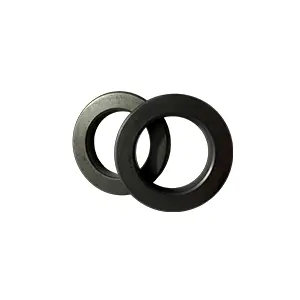
Ferrite ring manufacturing
(For confidentiality purposes, the product images shown are representative illustrations only and do not depict actual client-specific product)
Powder Metallurgy Process for Magnetic Rings
The typical manufacturing workflow for magnetic ring components includes the following steps:
1. Powder Preparation
Magnetic materials such as ferrite powder or iron powder are prepared and mixed with lubricants or binders to improve flowability during pressing.
2. Die Filling
The powder is fed into a precision die cavity designed according to the required ring geometry.
3. Powder Compaction
A mechanical powder press applies high compressive force through upper and lower punches, forming the powder into a dense green compact.
4. Ejection
The formed compact is carefully ejected from the die to prevent cracking or deformation.
5. Sintering
The compact is heated in a controlled atmosphere furnace to achieve final density and magnetic performance.
Key Challenges in Magnetic Ring Pressing
Although powder metallurgy is highly efficient, magnetic ring forming presents several technical challenges.
Density Uniformity
Uneven density distribution can lead to inconsistent magnetic properties and mechanical strength.
Cracking During Ejection
Thin ring structures are susceptible to cracking during the ejection stage.
Dimensional Precision
Magnetic rings often require tight tolerances to ensure proper assembly in electronic components.
Powder Flow Characteristics
Magnetic powders sometimes have poor flowability, which can affect filling uniformity and pressing stability.
Because of these challenges, high-precision powder pressing equipment is essential.
Why Mechanical Powder Press Machines Are Used
A mechanical powder press machine provides several advantages for magnetic ring production.
High Pressing Speed
Mechanical presses convert rotary motion into linear pressing force, enabling high-speed production suitable for mass manufacturing.
Precise Stroke Control
Stable bottom dead center positioning helps ensure consistent part dimensions and density distribution.
Multi-Level Pressing Capability
Advanced powder presses can support multi-level pressing structures, allowing complex shapes such as stepped rings.
High Repeatability
The rigid mechanical transmission system provides excellent repeatability, which is essential for large-volume production of magnetic components.
These features make mechanical presses a preferred choice in many powder metallurgy production lines.
Mechanical Powder Press vs Hydraulic Powder Press
Both mechanical and hydraulic presses are used in powder metallurgy manufacturing, but their performance characteristics differ.
| Feature | Mechanical Powder Press | Hydraulic Powder Press |
| Production speed | High | Medium |
| Cycle time | Short | Longer |
| Energy efficiency | High | Medium |
| Precision repeatability | Excellent | Good |
| Best application | Mass production | Complex or large parts |
For high-volume production of relatively small parts such as magnetic rings, mechanical powder presses are often preferred due to their productivity.
Applications of Magnetic Ring Components
Magnetic rings produced by powder pressing technology are widely used in modern electronics and electrical systems.
Typical applications include:
Inductor magnetic cores
Transformer cores
Motor stator components
EMI suppression ferrite rings
Power electronics magnetic elements
With the rapid growth of electric vehicles, renewable energy systems, and high-frequency electronics, the demand for magnetic components continues to increase.
This trend is driving the adoption of high-precision powder compacting press machines in the powder metallurgy industry.
Future Trend: Servo Mechanical Powder Press
In recent years, the powder metallurgy industry has begun upgrading traditional presses to servo mechanical powder presses.
Servo drive systems provide:
programmable motion profiles
adjustable pressing speed
improved energy efficiency
higher process control flexibility
These advantages allow manufacturers to further optimize powder compaction processes for high-precision components such as magnetic rings.
Engineering FAQ
1. What is a mechanical powder press? ▼
2. What materials are used for magnetic ring pressing? ▼
3. What tonnage is typically required for magnetic ring forming? ▼
4. Why is density control important in magnetic ring production? ▼