


 +86 15913754357
 sales@xirotech.cn

Common Press-Fit Problems in Ceiling Fan Motors and How Servo Press Machines Provide a Complete Assembly Solution丨XIRO
 Release time:2025.11.27
Ceiling fan motors are widely used in residential and commercial applications, and their performance directly affects product reliability, noise level, and service life.
During motor assembly, press-fit operations—such as shaft insertion, bearing installation, and rotor–stator assembly—are critical processes that demand high accuracy and repeatability.
However, many manufacturers still rely on traditional pneumatic or hydraulic press machines, which often lead to:
Inconsistent press-fit force
Difficulty in controlling press depth
Hidden defects caused by over-pressing or under-pressing
Limited process traceability and quality data
These issues make it increasingly difficult to meet modern manufacturing requirements for quality control, automation, and smart production.
This is where electric servo press technology provides a reliable and measurable solution.
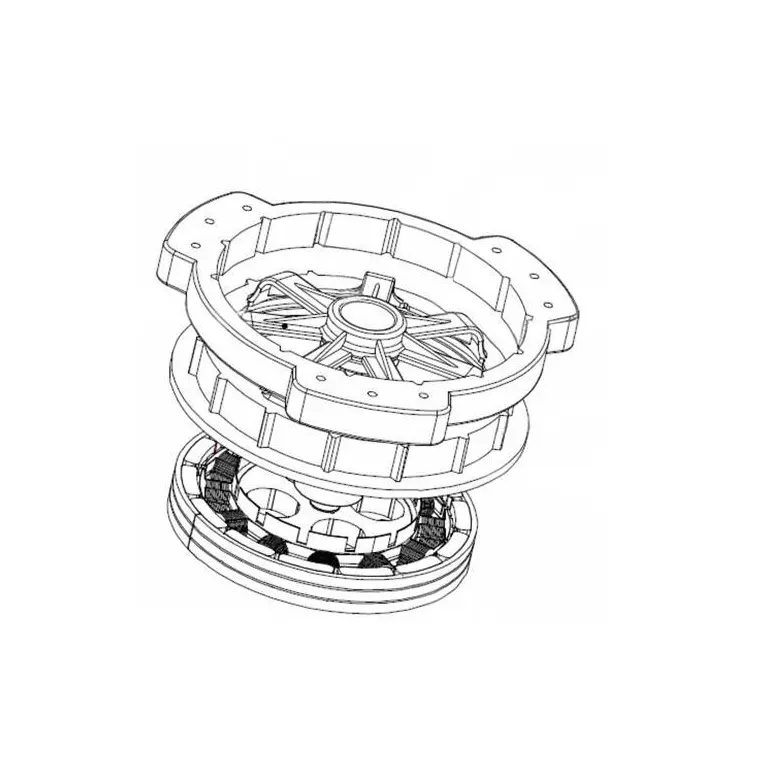
Ceiling fan motors
(For confidentiality purposes, the product images shown are representative illustrations only and do not depict actual client-specific product)
Common Press-Fit Problems in Ceiling Fan Motor Manufacturing
In ceiling fan motor assembly lines, the most common press-fit challenges include:
1. Unstable Pressing Force
Traditional presses cannot accurately control force throughout the stroke, leading to variations that affect bearing preload and shaft alignment.
2. Poor Control of Press-Fit Depth
Mechanical stops or time-based control methods are insufficient for precision motor components, increasing the risk of axial deviation or internal stress.
3. Lack of Quality Monitoring
Without real-time force–displacement monitoring, defective assemblies may pass inspection and cause noise, vibration, or early failure during operation.
4. Low Process Repeatability
Differences between operators, tooling wear, and environmental changes result in inconsistent assembly quality.
Why XIRO Electric Servo Press Is Ideal for Motor Assembly
An electric servo press machine uses a servo motor combined with a high-precision ball screw or roller screw system. This structure enables closed-loop control of force, position, and speed during the entire pressing process.
Compared with pneumatic or hydraulic presses, servo presses offer several decisive advantages:
High-precision force and position control
Real-time monitoring of force–displacement curves
Programmable multi-stage pressing profiles
Automatic defect detection and rejection
Full production data traceability
These capabilities make servo presses particularly suitable for ceiling fan motor press-fit applications.
Typical Servo Press Applications in Ceiling Fan Motor Assembly
Electric servo presses are commonly used in the following motor assembly processes:
Shaft Press-Fitting
Precise control of insertion depth and force prevents shaft deformation and ensures stable rotor alignment.
Bearing Installation
Servo presses allow smooth, low-impact bearing insertion, reducing internal stress and extending bearing life.
Rotor and Stator Assembly
Force–displacement curve monitoring ensures proper interference fit and detects abnormalities such as misalignment or foreign particles.
End Cap and Housing Assembly
Multi-stage pressing profiles help avoid housing cracks and ensure consistent axial positioning.
Force–Displacement Monitoring for Quality Assurance
One of the most important features of a servo press is force–displacement curve analysis.
During each press cycle, the system records real-time force and position data. By defining an acceptable curve window, the servo press can:
Instantly detect abnormal press-fit conditions
Automatically reject defective parts
Store process data for quality audits and traceability
This function significantly reduces the risk of hidden defects and improves overall production yield.
Improving Automation and Production Efficiency
Electric servo presses are easily integrated into automated assembly lines, robotic cells, and smart factories.
Key automation benefits include:
Seamless integration with PLC and MES systems
Recipe-based parameter switching for different motor models
Reduced dependence on operator experience
Faster changeover and shorter cycle time
As a result, manufacturers can achieve higher throughput, stable quality, and lower labor costs.
Conclusion: A Reliable Press-Fit Solution for Modern Motor Manufacturing
As ceiling fan motor designs become more compact and performance requirements continue to rise, traditional pressing methods can no longer meet modern production standards.
An electric servo press solution provides:
Accurate and repeatable press-fit control
Real-time quality monitoring
Improved product reliability and service life
Strong support for automation and Industry 4.0
For manufacturers seeking to improve ceiling fan motor assembly quality and production efficiency, electric servo press technology is a proven and future-ready solution.